
Tire Size Conversion Calculator
Use this tire size conversion calculator to convert metric tire sizes to decimal inches and approximate flotation dimensions, or calculate metric geometry from inches.
Tire Specification Input
Single Tire Conversion1 inch = 25.4 mm. Calculated flotation codes are theoretical dimensional representations.Calculated Flotation-Style Representation for 285/70R17
Tire Dimensional Visualizer
Scaled radial profile with full wheel axial cross-section.
Calculations use documented geometric and mathematical relationships, with tire-industry standards and manufacturer specifications referenced where relevant.
How the Tire Size Conversion Calculator Works
To convert a metric tire size to inches, convert section width from millimeters, calculate sidewall height from the aspect ratio, and add twice the sidewall height to the rim diameter. To convert a flotation size to calculated metric-style geometry, reverse those dimensional relationships. Tire size conversion translates nominal dimensions between metric tire notation and inch-based flotation-style dimensions.
- Select your conversion direction (Metric → Inches or Inches → Metric).
- Enter your complete tire designation (e.g.
285/70R17or33x12.50R15) into the input field. - Review the Calculated Flotation-Style Dimensions or Calculated Metric-Style Geometry in the dominant hero card.
- Inspect the detailed 4-card dimension breakdown and the proportional 2D cross-section diagram.
Worked Conversion Examples: 285/70R17 & 33x12.50R15
The following tables demonstrate the calculated nominal dimensions generated by our calculation engine for both conversion directions:
Example 1: Metric to Inches (285/70R17)
| Parameter | Metric Value | Converted Inch Value | Calculation Method |
|---|---|---|---|
| Section Width | 285 mm | 11.22″ | 285 ÷ 25.4 |
| Sidewall Height | 199.5 mm | 7.85″ | (285 × 0.70) ÷ 25.4 |
| Nominal Rim Diameter | 431.8 mm | 17″ | Direct bead-seat diameter |
| Overall Tire Diameter | 830.8 mm | 32.71″ | 17 + 2 × (199.5 ÷ 25.4) ≈ 32.71″ |
| Flotation Representation | Approx. 32.7 × 11.2 R17 (Calculated flotation-style dimensional format; does not denote a commercial tire designation) | ||
Example 2: Flotation to Metric (33x12.50R15)
| Parameter | Flotation Value | Converted Metric Value | Calculation Method |
|---|---|---|---|
| Overall Tire Diameter | 33.00″ | 838.2 mm | 33.0 × 25.4 |
| Section Width | 12.50″ | 317.5 mm | 12.50 × 25.4 |
| Sidewall Height | 9.00″ | 228.6 mm | (838.2 - 381.0) ÷ 2 |
| Calculated Aspect Ratio | — | 72.0% | (228.6 ÷ 317.5) × 100 |
| Metric-Style Geometry | Calculated Metric-Style Geometry: 318/72 R15 (318 mm width, 72% aspect ratio) | ||
Metric Tire Size Conversion Chart
Common metric tire sizes with calculated overall diameter, section width, sidewall height, and approximate inch dimensions.
| Metric Size | Approx. Diameter Class | Overall Diameter | Section Width | Sidewall Height | Calculated Flotation-Style Dimensions |
|---|---|---|---|---|---|
| 215/75R15 | ~28″ | 27.70″ (704 mm) | 8.46″ (215 mm) | 6.35″ (161.3 mm) | 27.7 × 8.5 R15 |
| 235/75R15 | ~29″ | 28.88″ (733 mm) | 9.25″ (235 mm) | 6.94″ (176.3 mm) | 28.9 × 9.3 R15 |
| 245/75R16 | ~30″ | 30.47″ (774 mm) | 9.65″ (245 mm) | 7.23″ (183.8 mm) | 30.5 × 9.6 R16 |
| 265/70R17 | ~32″ | 31.61″ (803 mm) | 10.43″ (265 mm) | 7.30″ (185.5 mm) | 31.6 × 10.4 R17 |
| 265/75R16 | ~32″ | 31.65″ (804 mm) | 10.43″ (265 mm) | 7.82″ (198.8 mm) | 31.6 × 10.4 R16 |
| 275/65R18 | ~32″ | 32.07″ (815 mm) | 10.83″ (275 mm) | 7.04″ (178.8 mm) | 32.1 × 10.8 R18 |
| 275/70R18 | ~33″ | 33.16″ (842 mm) | 10.83″ (275 mm) | 7.58″ (192.5 mm) | 33.2 × 10.8 R18 |
| 285/70R17 | ~33″ | 32.71″ (831 mm) | 11.22″ (285 mm) | 7.85″ (199.5 mm) | 32.7 × 11.2 R17 |
| 285/75R16 | ~33″ | 32.83″ (834 mm) | 11.22″ (285 mm) | 8.42″ (213.8 mm) | 32.8 × 11.2 R16 |
| 275/65R20 | ~34″ | 34.07″ (865 mm) | 10.83″ (275 mm) | 7.04″ (178.8 mm) | 34.1 × 10.8 R20 |
| 305/70R17 | ~34″ | 33.81″ (859 mm) | 12.01″ (305 mm) | 8.41″ (213.5 mm) | 33.8 × 12.0 R17 |
| 315/70R17 | ~34″ | 34.36″ (873 mm) | 12.40″ (315 mm) | 8.68″ (220.5 mm) | 34.4 × 12.4 R17 |
| 325/65R18 | ~35″ | 34.63″ (880 mm) | 12.80″ (325 mm) | 8.32″ (211.3 mm) | 34.6 × 12.8 R18 |
*Note: Calculated flotation-style dimensions are geometric representations and do not necessarily correspond to commercially available tire size designations. Actual physical dimensions vary by tire brand, tread depth, and wheel rim width.
Tire Conversion Formulas & Step-by-Step Mathematics
Converting between metric tire notation and inch-based dimensions requires standard physical unit conversions (1 inch = 25.4 mm). Manufacturer-published revolutions per mile can differ from geometric estimates due to loaded tire deflection:
1. Metric to Inches Formulas
Section Width (in): Section Width (mm) ÷ 25.4
Sidewall Height (mm): Section Width (mm) × (Aspect Ratio ÷ 100)
Sidewall Height (in): Sidewall Height (mm) ÷ 25.4
Overall Diameter (in): Rim Diameter (in) + 2 × Sidewall Height (in)
Nominal Circumference (in): Overall Diameter (in) × π
2. Flotation to Metric Formulas
Section Width (mm): Section Width (in) × 25.4
Sidewall Height (in): (Overall Diameter (in) - Rim Diameter (in)) ÷ 2
Sidewall Height (mm): Sidewall Height (in) × 25.4
Calculated Aspect Ratio (%): (Sidewall Height (mm) ÷ Section Width (mm)) × 100
Understanding Tire Size Notation: Metric vs. Flotation
A tire size such as 285/70R17 encodes nominal section width, aspect ratio, radial construction, and rim diameter. From those values, its nominal overall tire diameter—sometimes informally called tire height—calculates to approximately 32.71 inches. Inch-based or LT high-flotation sizes such as 33×12.50R15 state nominal overall diameter and nominal section width directly in inches. P-Metric sizes use a P prefix for passenger tires, while LT-Metric sizes use LT for light-truck tires; the converter reads the dimensional portion of both formats. Flotation notation states nominal overall diameter and nominal section width in inches, along with rim diameter. For a complete explanation of tire markings, section width, aspect ratio, construction codes, load index, and speed rating, see How to Read Tire Size. U.S. regulations also require specified tire size designation, identification, and safety information to appear on tire sidewalls (NHTSA Tire Safety Standards).
Metric vs. Flotation Tire Size Notation
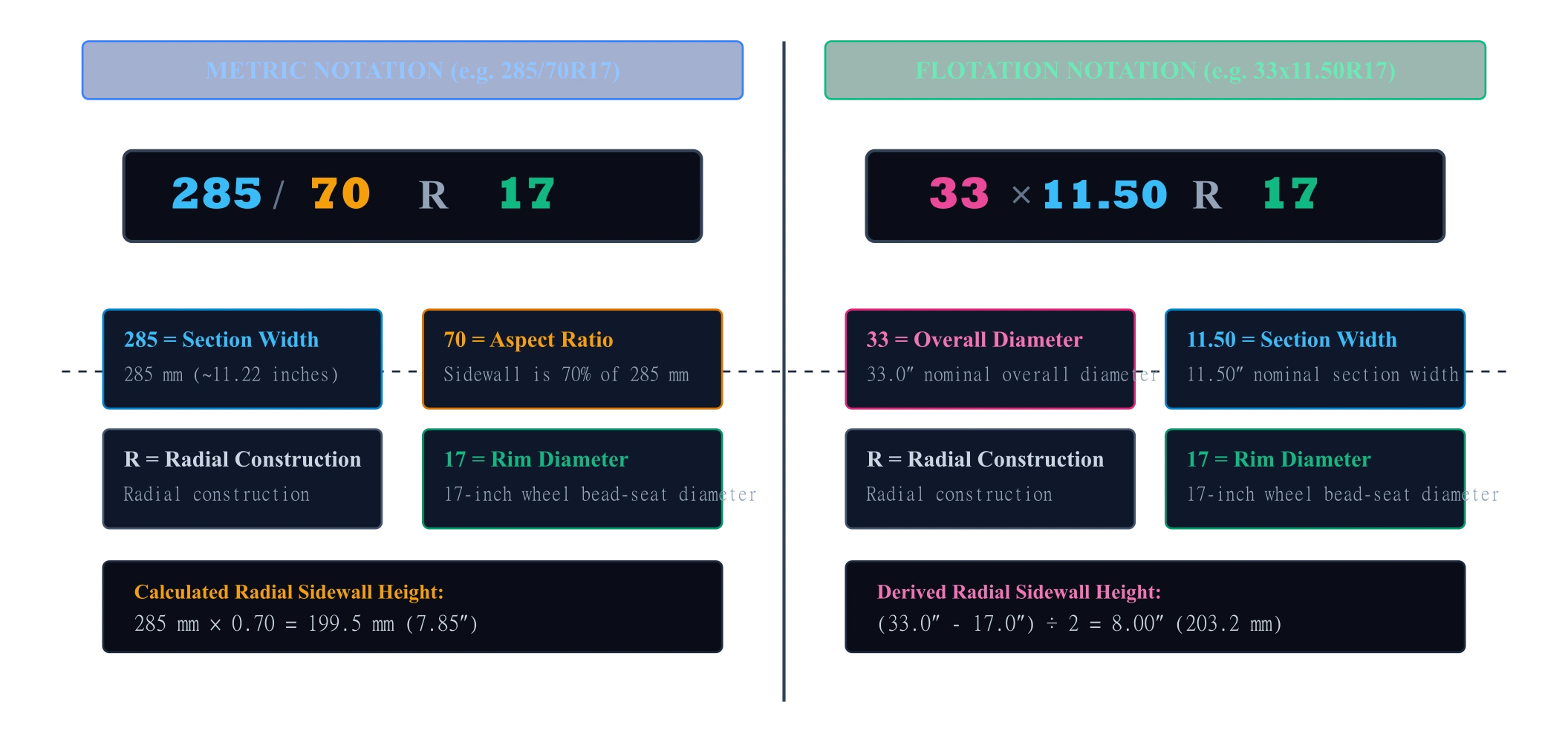
Visualizing Converted Dimensions on a Tire Cross-Section
When converting a metric size such as 285/70R17 into inch units, each physical component contributes to section width, sidewall height, nominal rim diameter, and overall tire diameter:
Metric to Inches Cross-Section Dimensions (285/70R17)

Nominal Conversion vs. Real-World Physical Dimensions
The calculations provided by TireCalculator.net represent nominal geometric dimensions derived from standardized unit conversions. In real-world automotive fitments, mounted tire dimensions vary based on several physical parameters:
- Measuring Rim Width: Mounted section width can change when a tire is installed on a rim width different from the manufacturer's measuring rim, as outlined in tire replacement technical information published by the U.S. Tire Manufacturers Association (USTMA).
- Inflation Pressure & Load: Inflation pressure and vehicle load affect tire deflection, loaded radius, and real rolling behavior. These effects are not represented by nominal tire-size geometry.
- Tread Depth: Overall tire diameter decreases as tread wears because tread depth contributes to tire radius. The change in unloaded diameter is approximately twice the radial tread-depth loss.
- Standardized Size Envelopes: The Tire and Rim Association (TRA) publishes tire designations, dimensions, load ratings, and approved rim information for the North American market.
Related Tire & Wheel Calculators
Need to compare two different tire sizes, calculate speedometer calibration error, or evaluate clearance deltas?
Frequently Asked Questions
A 285/70R17 tire has calculated nominal dimensions of approximately 32.71 inches overall diameter, 11.22 inches section width, and 7.85 inches sidewall height. Its calculated flotation-style dimensions are therefore approximately 32.7 × 11.2 on a 17-inch rim. This is a geometric conversion and does not necessarily correspond to a commercially manufactured flotation tire size. Its nominal diameter is roughly in the 33-inch class.
References
- National Highway Traffic Safety Administration (NHTSA) – Tire Safety & Sidewall Markings. U.S. Department of Transportation regulations regarding tire size designation and required safety/identification sidewall markings.
- U.S. Tire Manufacturers Association (USTMA) – Tire Replacement Guidelines. Industry technical information for passenger and light truck tire replacement, load capacity retention, and measuring rim width relationships.
- The Tire and Rim Association, Inc. (TRA). Standards organization publishing tire designations, dimensions, load ratings, and approved rim information for the North American market.